
With the improvement of production levels, manufacturers' requirements for product quality are constantly improving, and the sealing requirements for wires are also constantly increasing. In order to obtain the best performance of wire products, manufacturers often conduct sealing tests on wires.However, different types of wires have different requirements for sealing testing, especially wires with multi-wire connections, which are difficult to conduct sealing testing.As a well-known sealing testing and production expert, Hirays Technology has made many achievements in the sealing testing of wire rods. This time we will share two different types of testing cases for your reference:
1. Appearance display of wires
1. The first wire is in the shape of a long strip. One end of the wire is a blue wire connector. The shape is simple and well-proportioned. The outside is wrapped with black waterproof material. The connector and the wire are integrated into one line. It is difficult to fix it during inspection;
2. The second type of wire is a long wire with multiple joints. The joints are conventional cylinders, and the whole is protected with waterproof coating. The irregular shape is difficult to seal during detection, which is detrimental to direct detection;
2. Breakthrough in Difficulties in Wire Detection
1. It is easier to overcome the problem of single-ended wire testing. Put the single-ended wire into the tooling mold, and put the other end into the slot at the other end, so that the conduit connecting the instrument can fill the wire joint with gas, so that its air tightness can be judged by the internal air pressure state.

2. For the shape of the multi-wire connector, Haris has a special grinding tool to hold it. The connector is placed in the mold and stuck just right. This facilitates the upper and lower closing of the mold during inspection. When inflating the body in the mold, it can avoid gas leakage and lead to numerical errors.

3. Demonstration of wire sealing testing process
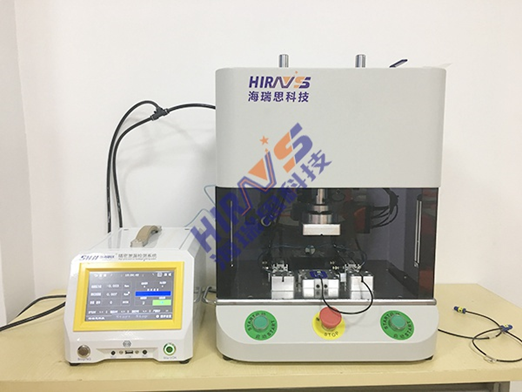
1. First, we put the wire interface and the wire at the other end into the insertion slot and fix it. The conduit is connected to our instrument. There is a valve island, gas tank and other components inside the instrument as well as the program we have set. After the connection, press the start button when detecting the laser wire.
2. Put the second wire into the mold of another tooling. The mold is closed up and down to form a closed space. The conduit is connected to our instrument. Set the program as above and press the start button;
3. During testing, the instrument will inflate the inside of the wire interface.If the wire interface is not sealed and air leakage occurs, the leakage value displayed in the instrument will become larger and larger, and the pressure value will decrease at the same time.At this time, you can determine whether the wire or wire interface is leaking. The instrument test result will also show NG, which means the air tightness test failed.If the tested wire interface does not leak, the gas in the tooling mold will be in a constant state after inflation, and the pressure value and leakage value displayed on the instrument will also be stable. The instrument test result will display OK, indicating that the waterproof test has been passed.
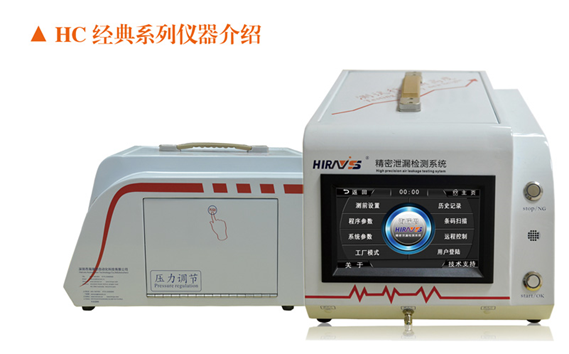
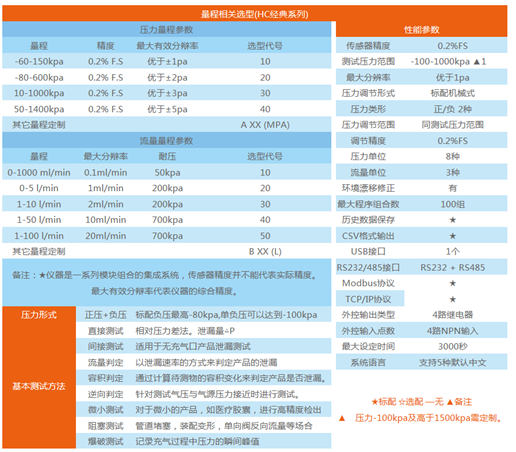
4. Parameter table of wire sealing tester
The copyright belongs to Hirays Technology. Reprinting and counterfeit originality are prohibited. Any violation will be at your own risk.


